
Clear technical answers regarding operational efficiency, material compatibility, and factory integration.
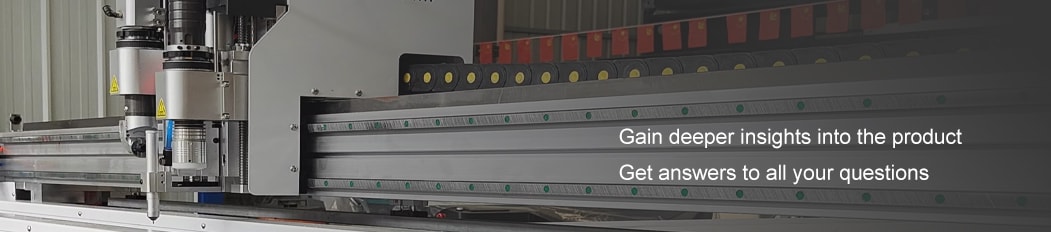
A: The system utilizes high-frequency vertical blade vibration driven by precision servo motors to shear through flexible materials with an accuracy of ±0.2mm. Unlike laser cutters, our automatic CNC cutting machine operates with cold-cutting technology, eliminating smoke, toxic fumes, thermal edge deformation, and edge burning. This makes it ideal for heat-sensitive materials such as rubber sheets, foam, and synthetic leather.
A: Our equipment has been thoroughly tested across various industrial applications:
A: Material shifting is completely prevented by our multi-zone vacuum suction table. The high-pressure vacuum system features up to 12 independently controlled suction zones that concentrate hold-down force directly beneath the cutting area. Even during high-speed directional changes (up to 1000mm/s feed rate), materials remain perfectly flat and immovable.
A: Not at all. Over 95% of operator teams master full machine operations within 3 to 7 days:
A: When matched with the correct blade frequency and cutting tool head, the cutting edges are smooth, square, and completely burr-free. If you want to verify edge quality for a specific compound, we offer free sample testing—send us your material or drawing, and we will record a full cutting demonstration video for your evaluation.
A: Knife cutting offers distinct operational advantages for flexible substrates:
• Vs. Laser: Zero smoke, zero burnt edges, zero toxic odor, and lower power consumption.
• Vs. Waterjet: No wet materials, no messy abrasive disposal, and significantly lower operating & maintenance costs.
In addition, integrated CAD auto-nesting software increases material yield up to 95%, sharply reducing raw material waste.
A: It excels at both. For short-run custom prototyping, digital cutting eliminates die-cut tooling costs and lead times. For continuous high-volume production, our automatic CNC cutting machine can be equipped with an automated conveyor feeding table and roll-unwinding racks, allowing uninterrupted continuous feeding and cutting for bulk orders.
A: Our operating software natively imports common vector formats including DXF, PLT, AI, and PDF. You can continue designing in your preferred software (AutoCAD, CorelDRAW, SolidWorks, Adobe Illustrator) without changing your workflow.
A: Operator safety is built into the core design. Features include 4-corner infrared anti-collision sensors that halt axis motion if an obstacle is detected, physical emergency stop palm buttons, mechanical blade enclosures, and software limit protection to prevent accidental mis-operation.
A: Mechanical maintenance is minimal. Routine procedures involve periodically wiping down and lubricating linear guide rails, inspecting vacuum filters, and changing tungsten blades as they wear down.
Contact our application engineers for a free cutting trial or a customized equipment quotation.
Shandong ZXZ CNC Equipment Co., Ltd provides vibrating knife cutting machine, mainly through oscillating knife to cut flexible materials, including asbestos/non-asbestos/graphite/PTFE sheet/rubber/PVC sheet/clothing fabric/packaging/cardboard/leather, etc. The oscillating knife cutter we provide has a high cost performance, contact us immediately for more information.


Kathery Cui (sales 1):
 |
Whatsapp: | +8615222735180 |
 |
Email: | cutcnc@chn-rubber.com |
 |
Mobile: | +8615222735180 |
Diana Fu (sales 2):
|
Whatsapp: | +8618222051167 |
|
Email: | zxzcnc@chn-rubber.com |
|
Mobile: | +8618222051167 |
Shandong ZXZ CNC Equipment Co.,Ltd
Dujiamiao village, Shizhong District, Jinan City, Shandong Province, China